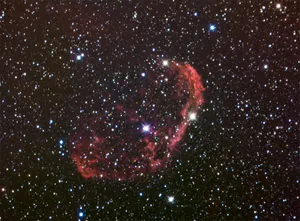
Starting Crescent Nebula – NGC6888
2011-10-08
With a little imaging time left in the evening, I started on NGC6888, the Crescent Nebula, as it is now well positioned in my limited hole in the sky.
The moon was quite bright — between 1st quarter and full — and washing out the sky a little. However, NGC6888 is an emission nebula, so produces a fair amount of H-Alpha light, and this is much less affected by moonlight.
The first night I managed 70 minutes in 10-minute subs. The next night, 90 minutes more in 15-minute subs. So, for the start of this project, this is 160 minutes of H-Alpha in 10-minute and 15-minute subs.

More data on this target will take several weeks, I imagine.
Oct 28: Green Light
The evening of Oct 28 it was clear for a couple of hours, so I gathered 2 hours of green data. This is 120 minutes as 12 10-minute subs, binned 2×2. This nebula and surrounding area is almost pure red, so it’s no surprise that it is barely visible in this green light.

Nov 5: Blue Light
Another clear night, after a lot of cloud and rain. Unfortunately there is a moon tonight, slightly past first quarter, so the sky isn’t as dark as I’d like. However, I’m using this rare clear night to gather more data; this time we’ll take Blue. I remember the blue channel tends to be the noisiest, so gathered 3 hours of data in 10-minute subs. (The shorter days and longer nights allow this to just fit in the window as the target moves between obstructions in the yard.)

Nov 21: Red Light
Finally a clear night, and with no moon. It’s cold, so I was also able to reduce the chip temperature to -30° for better noise reduction; and the earlier darkness (DST has ended) allowed me to start earlier. All these things combined to permit gathering 3 hours of Red, in 10-minute subs.

No ordinary Luminance data collected yet, but I now have 3 colour channels, so this is an RGB image in which the Red channel has been luminance-enhanced using the Hydrogen-Alpha data.

Dec 12: 3 hours Luminance
Added 3 hours of Luminance data in 10-minute subs.