
Starting Mount Forensics and Maintenance
It’s time to admit I have a mount performance problem
I am so impressed with the build quality of the MX mount that I’ve been reluctant to admit that there seems to be a performance issue showing up in my data. I think I’m ready to admit that now.
- There is pretty good evidence of a problem;
- I’m pretty sure it’s a rather basic problem, likely easily correctible (but only once I admit I have a problem and work on it);
- The SB support forums show excellent responses from both manufacturer and other users, and every problem someone reports and works through seems to be solved.
Symptoms of one or more problems
There are a couple of things that I’m sure are indications of problems, although it remains to be seen if there is a single underlying problem or several. The symptoms are:
Periodic Error (PE) is out of spec.
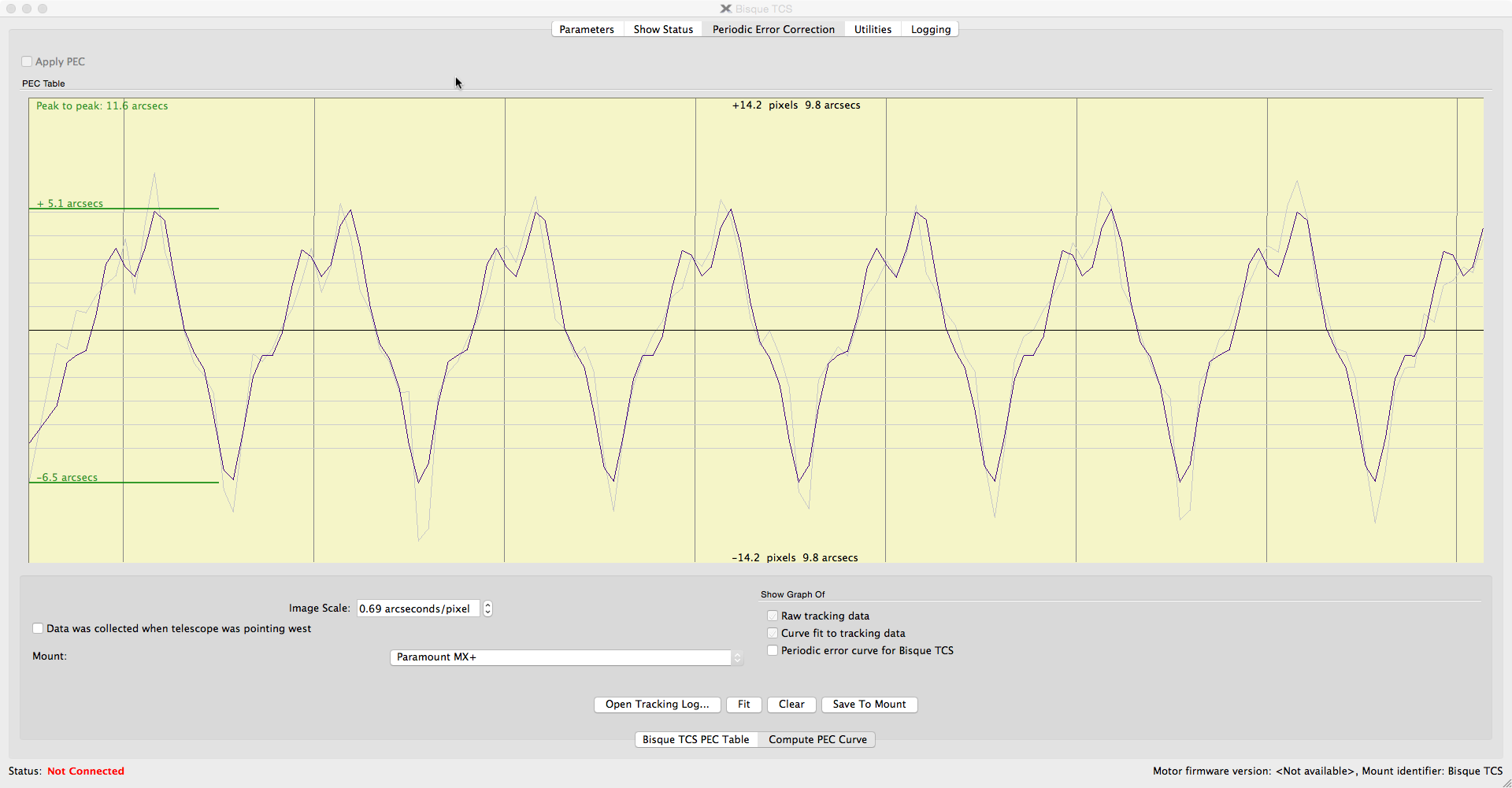
I gathered data incorrectly several times (mainly by forgetting to record the camera rotation angle, or to ensure it was 0° or 180°), so it took me a while to see this. However, now I have reliable data showing I’m getting uncorrected Period Error of almost 12 arcseconds, peak to peak.

The spec for the mount is “maximum 7 arcseconds, peak to peak”. And this isn’t just marketing hype – most Paramounts do much better, and the SB support forums are full of examples of SB being horrified in the rare case when someone’s mount exceeds this spec, and of SB taking it seriously to correct it.
Note that with Periodic Error Correction (PEC) active, the mount tracks at 3.9 arc seconds, which is quite good. However, I think I should work on getting the uncorrected performance into spec.

- Surely if I get uncorrected performance as good as possible, then PEC should improve corrected performance even more; and
- Surely being out-of-spec means something is wrong, and that problem could have other effects that show up in results, or that cause wear and tear on the mount’s drive mechanism.
So, I’ve resolved to work on this, with the minimum target of getting uncorrected PE into spec.
Strange Dec oscillation when guiding
Next, I’m getting very strange behaviour in the Declination axis when auto-guiding. At this point I don’t have a good theory for whether this is the same problem as the PE above, or a separate problem.
When autoguiding, there is no reason why there should be Dec motion or Dec corrections at all unless Polar Alignment is off, or unless ProTrack is enabled and making corrections that it thinks are needed.
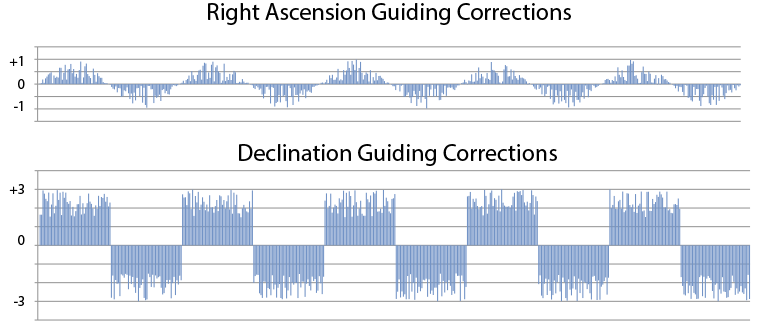
What I’m seeing in Declination is large-scale, slow-period oscillation in the Dec axis. Dec shows as being several arc-seconds off, but multiple successive autoguiding periods don’t seem to be able to correct it. Then it suddenly swings over to being several arc-seconds off on the other side of the axis. At no point does it converge to a “no or small error” state. (This image is a simulation since I forgot to take screen captures the last time I did this test.)

Aside from the obvious – that this indicates something is wrong – this also means that I can’t use dithering when collecting a series of images. After the first image, guider “settling” back within a specified error range never happens. RA settles quickly, but Dec just keeps oscillating from far-off on one side to far-off on the other side.
Things that look odd but I’m not sure are symptoms of problems
The above two issues are things that I’m sure are problems. There are also a couple of other strange things going on that I’m not sure are problems, but they look odd.
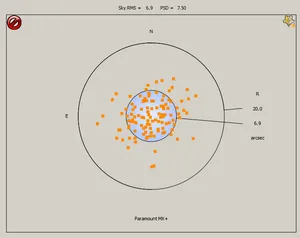
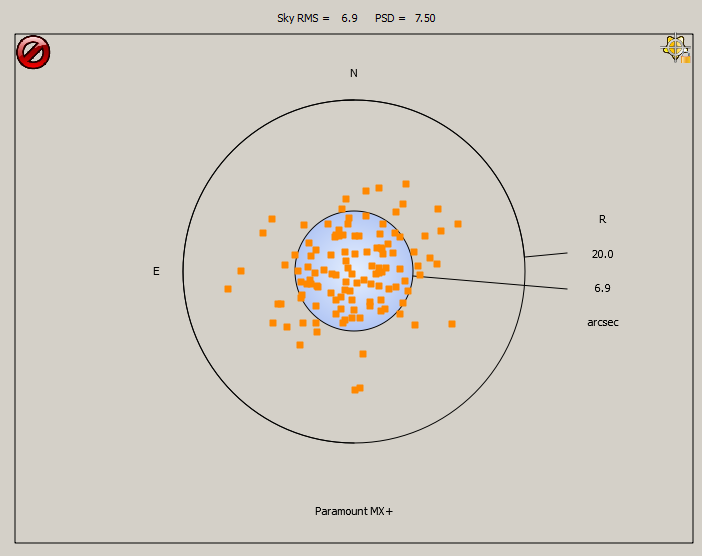
First, my TPoint model isn’t very good. The point-spread graph is quite spread-out, and quite oblong. This is probably just another symptom of the same problem causing the above issues. It could also be giving ProTrack ammunition to make bad adjustment decisions, compounding the problem.

Second, I note, when gathering uncorrected data for doing a PE calibration, that I’m getting a large measured declination drift, in addition to the expected periodic error in Right Ascension. I haven’t thought through the mechanics enough to know if this is normal or an indicator of a problem.
Research in support group
I spent quite a bit of time searching through the SB support forums and documents (which are not well organized, and not easy to search, by the way). Here are some miscellaneous points I’ve noted – in no particular order.
- Polar alignment is important, of course. If it’s off, drift will occur in both axes, compounding error. (I’m quite sure mine is quite good.)
- Camera rotation is critical when gathering data to analyse PE. It must be close to 0 or 180 degrees. If it’s in-between, PE is masked by being distributed between the RA and Dec axes. (I made this mistake several times, gathering PE data with a poor camera angle.) I note that the software could be coded to correct for this (if given the rotation value), but it isn’t.
- ProTrack affects tracking. That’s its job; but, when diagnosing problems, start by turning it off so we’re looking at “raw” performance, and to help determine whether ProTrack (or the TPoint model that drives it) are part of the problem.
The most common causes of problems seem to be:
- Flexure in system (mirror flop, loose physical mounting, etc.). Externally, I’m pretty sure I have this under control, but there could be something loose inside the mount.
-
Problems with worm gears, any of:
- Spring tension plungers needing adjustment;
- Cam stop needing adjustment;
- Pivot screws being loose;
- Various other mounting screws being loose;
- Rarely: gears or gear assemblies needing service or replacement.
- There are some reports of through-the-mount cabling contributing to problems, if the cables tangle, don’t have the necessary slack, bind against internal shafts or surfaces, or “wind and unwind”, contributing force to the expected movement of the shafts.
- Tension on the drive belts can also be checked and adjusted. It’s not clear how incorrect tension would cause the problems I’m seeing, but it’s easy to check and it would presumably contribute to longevity of the belts to ensure it’s correct.
Hypotheses
To be confirmed by experimental corrections and measurements, my hypotheses for my problems are:
Higher-than-spec PE
I think the spring plungers on my RA worm gear are too tight. If they were too loose, it wouldn’t affect normal RA tracking (but would show up as backlash in slews, and in TPoint). Too tight, however, might be causing gear friction, stiction, or over-sensitivity to minor machining imperfections.
Through-mount cabling could also be contributing to uneven PE performance if cables are binding.
How to test this hypothesis:
- Check TPoint model for RA backlash, which would suggest “too loose” and disprove this hypothesis;
-
Make a new PE data-gathering run after making the following checks and adjustments.
- Temporarily remove all in-mount cabling, routing cables on the outside;
- Adjust the RA spring tension plungers to spec;
- While I’m in the RA gear box, adjust cam stop and confirm other mounting screws are tight.
Erratic Dec during guiding:
I think the spring plungers on my Dec gear are too loose. Backlash could be causing the non-response to guiding adjustments, and is probably also polluting the TPoint model and causing ProTrack to make adjustments. Occasional ProTrack “adjustments” could be responsible for periodically throwing the Dec error to the other side of the zero axis.
Through-mount cabling could also be contributing to uneven performance if cables are binding.
How to test this hypothesis:
- Check TPoint model for Dec backlash, which would confirm “too loose” and support this hypothesis;
-
After fixing PE as planned above, do a new guiding test after making the following
adjustments:
- o Temporarily remove all in-mount cabling, routing cables on the outside;
- o Adjust the Dec spring tension plungers to spec;
- o While I’m in the Dec gear box, adjust cam stop and confirm other mounting screws are tight.
Plan to deal with it
So, here is the plan to work through this problem. The plan will need adjustments as data come in.
- Change mount-to-pier fastening (see post of 2018-4-14)
- Remove through-mount cabling. (Temporarily – I like it, and hope to be able to restore it once I understand its role, if any, in the problem.)
- Check and adjust Cam-Stop on both axes
- Check tightness of worm-end pivot screws, both axes
-
Check that RA and Dec worm plungers are adjusted to spec.
It wasn’t easy to find out what the spec is: the SB documentation isn’t well organized. The specs are:
- Cam Stop 1/8 turn back from bottomed out (measured with clutch in “run mode”);
- Spring tension plungers: 3 to 3.5 turns back from bottomed out. (measured with clutch in “balance mode”)
- Check belt tightness, both axes
- Do a new 20-30 point TPoint run to verify polar alignment is good
-
Carefully record uncorrected Periodic Error
- double-check camera angle is 0 or 180
- double-check PEC, TPoint, ProTrack, and Guiding Relays are off
- keep a plate-solved image to verify camera angle and image scale
- keep the gathered guiding log, and a screen shot of the data gathering graph
- hoping, with above adjustments, PE will fall in spec; get help if not
-
Upload PE Correction and record results
- double-check “west side of mount” checkbox is correct
- do a PE recording with PEC on but TPoint and ProTrack still off
- keep the gathered guiding log, and a screen shot of the data gathering graph
- residual error should be on order of 1 arcsecond
-
Carefully record an autoguiding run
- compute autoguider correction parameters with CCDWare calculator
- hoping strange Dec issues gone; get help if not
-
Reset TPoint
- do a new large run (150+ stars) and supermodel
- verify if it still thinks I have good polar alignment
- test unguided tracking, with PEC and ProTrack on
- test guided tracking with PEC and ProTrack
-
Restore through-mount cabling
Replace through-mount cabling, one cable at a time, verifying PE and guiding after each. This will be a slow and painful process, that I’ll work at as other reasons to take OTA off mount arise.